Potts the Printers
The importance of Newcastle and Tyneside to the Industrial Revolution in the UK is well documented. It was the birthplace of steam locomotives and the modern railways; it was a major provider of coal and ships, as well as being an exporter of glass, salt and lead. Newcastle and its surrounding towns grew in population at a rapid pace – the city’s population grew from 28,000 in 1820 to 215,000 in 1900.
To support this growth there grew a printing industry, especially in North Shields. To meet the need created by the shipping activities, including the requirements for almanacs, maps and other navigational documents, William John Potts founded a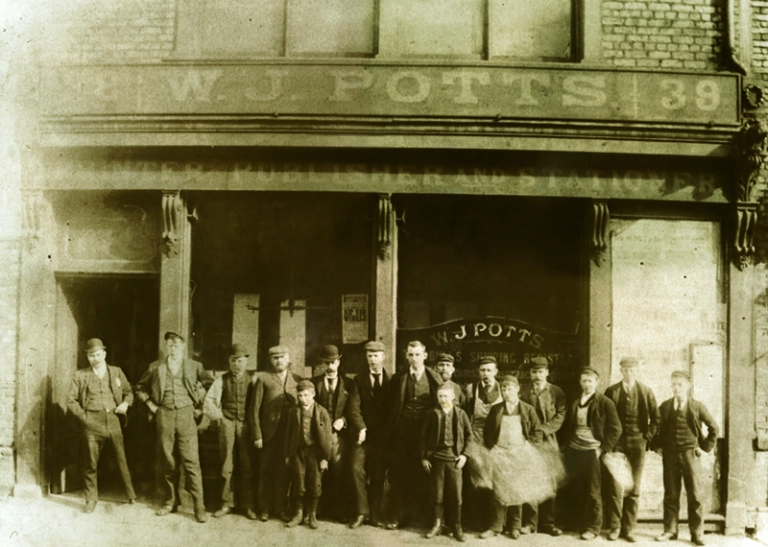 company in his name (W. J. Potts & Sons) in 1875. They were a publisher as well as printer - Bergen's Marine Engineer (1884), Pott's Mining Register and Directory for the Coal and Ironstone Trades of Great Britain and Ireland (1893) and Tynemouth Priory, by Canon Herbert S. Hicks (1910) were typical. They were based at the Atlas Printing and Publishing Works, 38-39 Bedford Street. This site was the former printing works known as R Surtees & Sons, believed to have been established in 1840 and in some of the advertising literature produced by W. J. Potts & Sons it was claimed that they were founded in 1840! W. J. Potts may well have served his printing apprenticeship with Surtees.
There is no doubt that W. J. Potts & Sons was a very successful business. When W. J. Potts died in 1908, aged 68, his estate was valued at the modern equivalent of over £1,000,000, as he owned many properties in north Tyneside as well as the printing/publishing business
In publicity material supplied by the current company it is stated that the business split at the very beginning of the 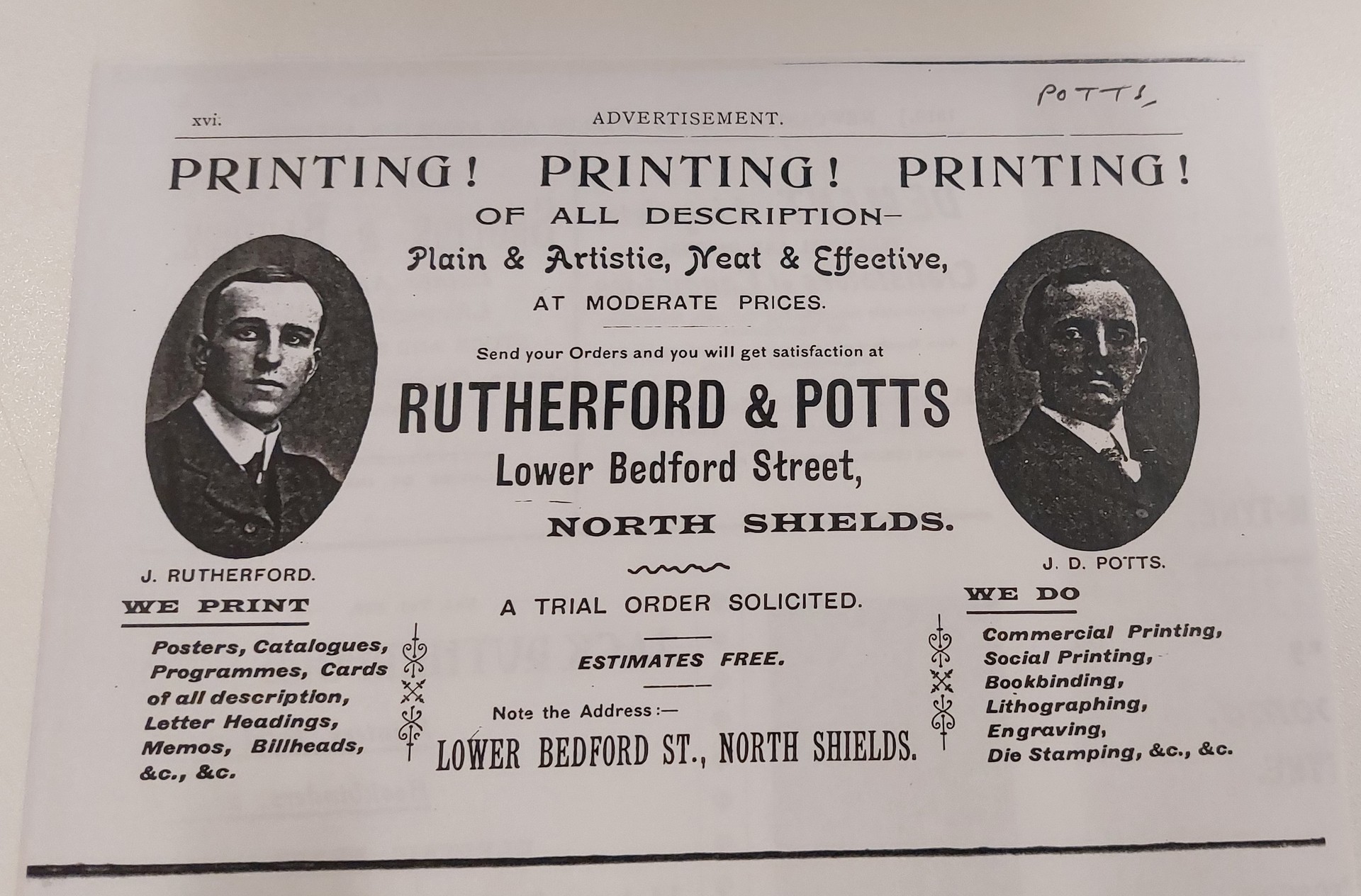 20th Century, with W. J. Potts retaining the publishing part of the business and the new “Rutherford and Potts” business, with John Dryden Potts working with John Rutherford, taking the printing work. I’m not sure if all the evidence supports this, but what we do know, via an announcement in the London Gazette of December 1908, is that the “Rutherford and Potts” company, described as “Printers, Publishers and Stationers” and based at 127a Bedford Street, North Shields was dissolved in August 1908, with John Rutherford continuing the business on his own. This tends to suggest that it was an independent venture rather than part of W. J. Potts & Sons; however, is there a connection to the death of W. J. Potts in April, 1908?
By 1914 there were three “Potts the Printers” in North Shields. W. J. Potts & Sons continued under the management of W. J. Potts’ son-in-law, John Leslie-Smith who had married Annie Potts in 1899; William Bain Potts, one of W. J. Potts’ sons was operating in partnership with others at 48 Camden Street as “The Camden Press”; and John Dryden Potts had a fledgling business in Waterville Terrace. Three points to make from this:–
-
before W. J. Potts’ death his son-in-law John Leslie-Smith and daughter Annie and family had been living in Glendale, near Wooler in north Northumberland where Leslie-Smith had been working as a clerk for the Police force. Although a later census would record Leslie-Smith as a “master printer” it’s not clear if he had gone through a printer apprenticeship;
-
none of W. J. Potts’ other children were involved with the printing business. Later adverts from the company (see below) list only J. Leslie-Smith and A. Leslie-Smith as partners; and
-
it is not clear how much involvement William Bain Potts had with the running of the “Camden Press” as he qualified as a second mate in 1887, appeared in the 1901 census as a “master mariner” and by 1911 his family had moved to Wanstead in Essex. He was awarded campaign medals for his service in the merchant service during World War I and never returned to Tyneside on a permanent basis.
In November 1915 a disaster hit W. J. Potts & Sons. In a report from the Tynemouth based “Shields Daily News”, dated 27th November 1915, there is a vivid description of the massive damage to the Bedford Street premises caused by a fire. It stated that “The Atlas Printing and Publishing Works, situated in Bedford Street and Church Way, North Shields were completely destroyed by the fire last night”. The newspaper described the Works as consisting “of a large block of buildings, about 40 yards in depth, with frontages both in Bedford Street and Church Way.” The printing business therefore occupied the northern end of that block of buildings. The printing works were on the second floor and so the heavy machines fell through into the ground floor as the fire destroyed the flooring.
Significantly, the newspaper report describes the proprietor as Mr J. B. Leslie-Smith, who was in a meeting in the offices in Church Way when the fire started. He and the others weren’t aware of the fire until they left the building; it’s not known where the fire started but it quickly spread throughout the Church Way part of the buildings and then spread to the Bedford Street side. Fortunately no one was killed or injured although another paper’s report details some close calls. Efforts by the Fire Brigade and volunteers failed to save the print works, the printing machinery and the stock of publications and paper but minimised damage to adjoining properties.
The newspaper article concludes “The Atlas Works were established by the late Mr. W. J. Potts and since his death the business has been carried on by his son-in-law, Mr. J. B. Leslie-Smith. Among the publications issued annually from the works were: - Turnbull’s Ship[ping Register, Bergen’s Marine Engineer, Potts’ Mining Register and Directory, and Potts Registry of Steam Ships. Most of these were in hand, and not only was the entire work destroyed “but the complete description of the records represents a serious loss which is difficult to estimate.” The article was repeated almost verbatim in the Newcastle Journal on the same day, but with the following addition: “Mr Leslie-Smith told our representative last night that not only had the whole of the above annuals been destroyed but also several important printing jobs which had been in hand.”
The fire had started somewhere between 7 and 8pm; by midnight it had been brought under control but parts of the building were still burning. This was a serious loss, not only in terms of capital and revenue, but also reputation. As this took place during the First World War rebuilding of any form would have been, I assume, even more difficult than if it had been attempted during a normal period.
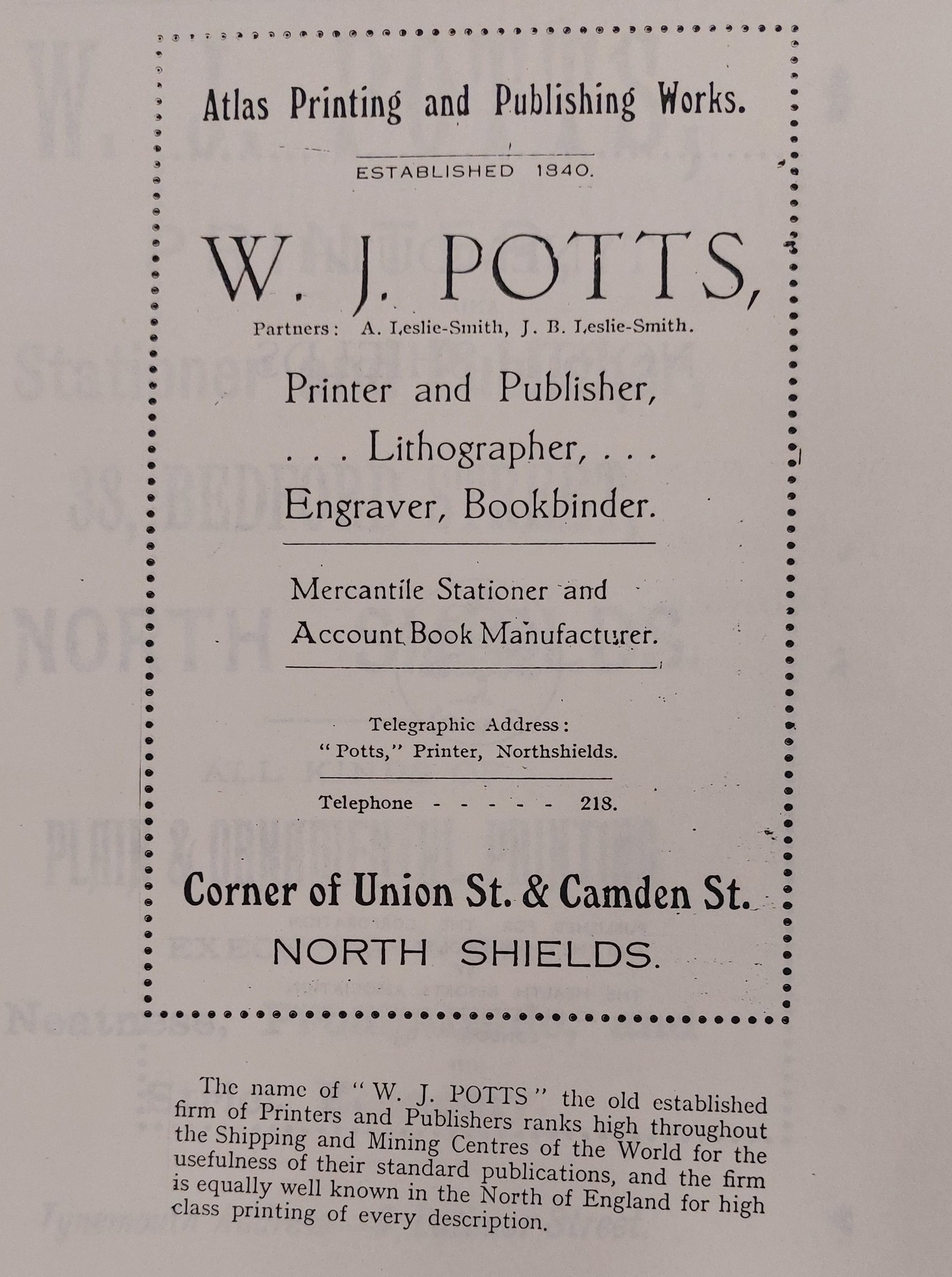
John Leslie-Smith appears to have continued the business but, I suspect, in a lesser form. At some point it moved to a new site on the corner of Union Street and Camden Street, not far from the original site in Bedford Street and then to Camden Street where, according to his probate record, he died in 1936. The Trade directory for 1930 shows W. J. Potts operating as “stationers”, whereas the same directory shows J. D. Potts in Little Bedford Street as “printers”.
Perhaps the only beneficiary from this disaster was John Dryden Potts’ business which moved from his home to Little Bedford Street, close to the other printers, although I am uncertain as to the date of the move. This business is still active today. J. D. Potts’ younger son George Gray Potts (John Anderson's great-uncle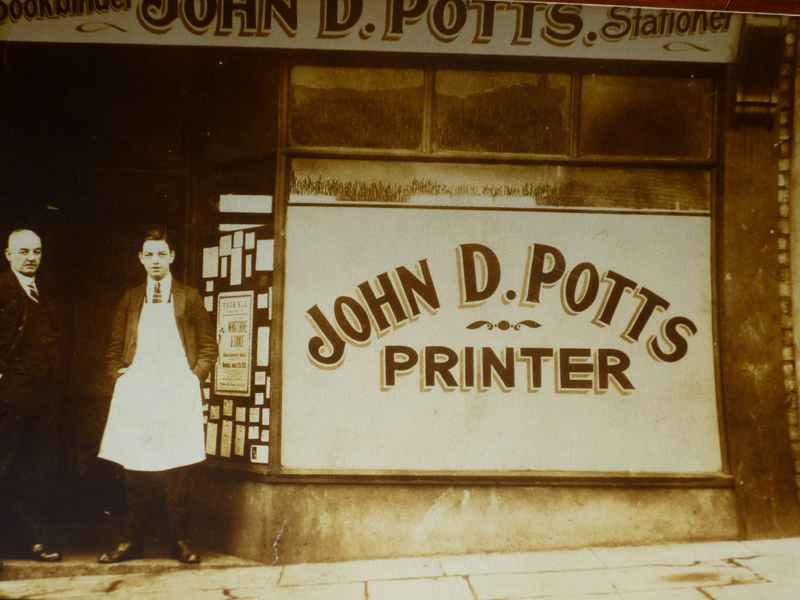 and Alan Potts' father) joined as an apprentice in 1930, eventually taking over as managing director in 1954 when the company became incorporated as Potts Printers Limited. After George’s retirement Stuart Couch, who had joined as an apprentice compositor in 1950 became general manager in 1965 and managing director in the mid-1970s. His son, Michael Sandford-Couch now runs the business which moved to new premises in Nelson Park, Cramlington in 2006. In 2010 the company was rebranded as Potts Print (UK) Ltd. On 1 May 2012, the company achieved Carbon Balanced Publication Printing Company status. The Potts family involvement came to an end when George’s wife Norma resigned as a director in 1992.
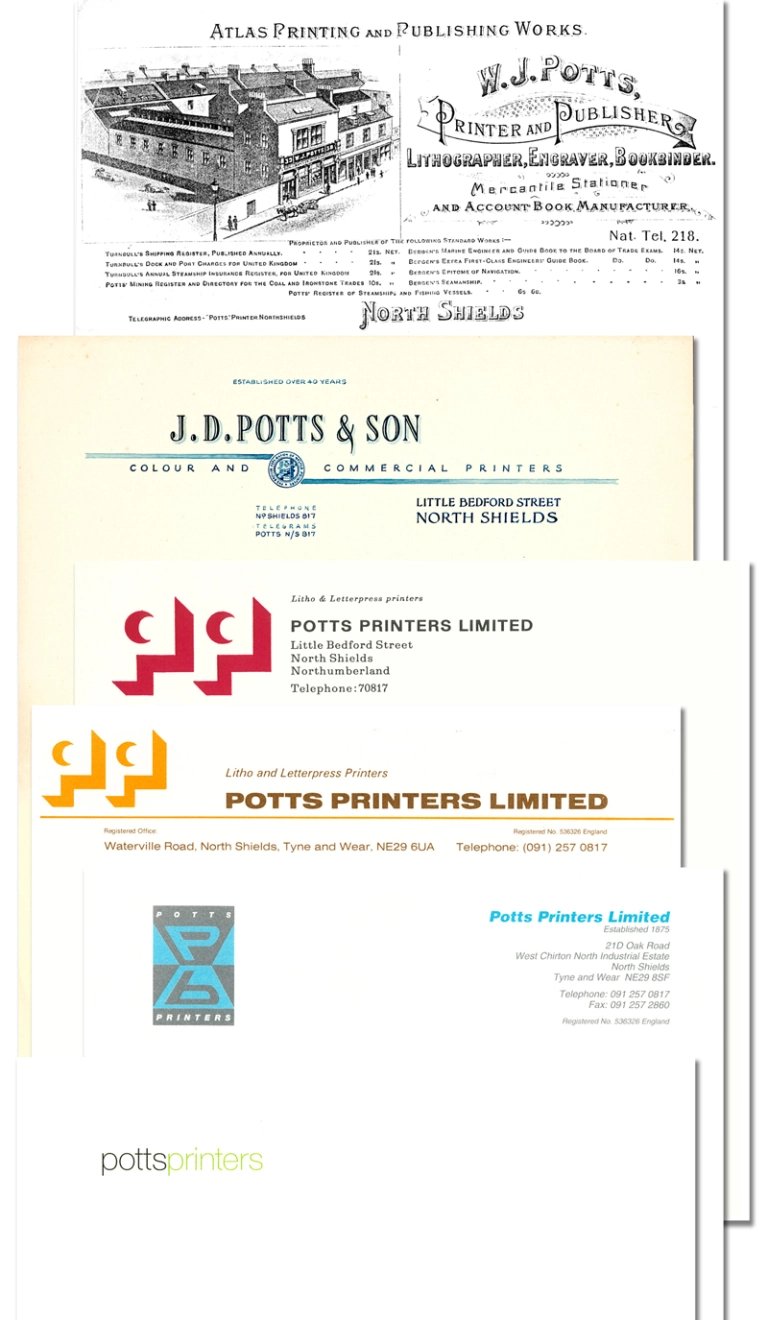
If you were to look at some of the literature produced by the company in the past and their current page on Wikipedia then you will see some discrepancies in their account of the company’s history compared to mine. For instance, they say that John Dryden was William John’s brother and took over the company after William’s death, which is patently not true as John Dryden didn’t have a brother, only half-brothers who were younger. There are other discrepancies but this is the main one; as I hope I have proved there is no connection between the company that W. J. Potts created, and the one that John Dryden made, the one that has become today’s Potts Print (UK) Ltd., other than John Dryden probably did his apprenticeship with W. J. Potts, and may have been involved in a possible split of companies in 1900-ish.
So were W. J. and John Dryden Potts related? Potts is a very common name in the north-east and I can find no familial connection, at least two of three generations back. However, both families have some presence in north Northumberland so there may be a connection further back than I can research at the moment.